The maritime industry is undergoing a massive digital transformation, but one fundamental law of physics remains unbroken: you cannot stream high-definition video from a moving ship in the middle of the ocean to a cloud server without encountering crippling latency and astronomical costs. This limitation is arguably the single biggest hurdle preventing widespread adoption of artificial intelligence at sea.
This is the "Bandwidth Bottleneck." For years, it has prevented fleet operators from leveraging computer vision to monitor their vessels. A typical commercial cargo ship relies on VSAT (Very Small Aperture Terminal) or L-Band satellite connections. While these links are sufficient for emails, weather updates, and basic telemetry, they offer highly limited bandwidth and suffer from significant latency. Sending multiple 1080p, 30-frames-per-second camera feeds continuously to the cloud for AI analysis is simply not economically or technically viable.
The Cloud AI Failure Point
Traditional terrestrial AI architectures assume abundant, fiber-optic-level bandwidth. They expect the cameras to act as dumb sensors, blindly sending all visual data to a centralized cloud brain for processing. At sea, this centralized model fails instantly. When an emergency occurs - like a fire in the engine room, a hazardous chemical spill on deck, or a man overboard - seconds matter. A cloud-based system that struggles to upload footage over a congested satellite link cannot provide the real-time alerts required to save lives.
Furthermore, if the satellite connection drops - a common occurrence during severe weather or when navigating through congested straits - a cloud-reliant AI system goes completely blind. Safety cannot be contingent on weather conditions.
The Edge Processing Solution
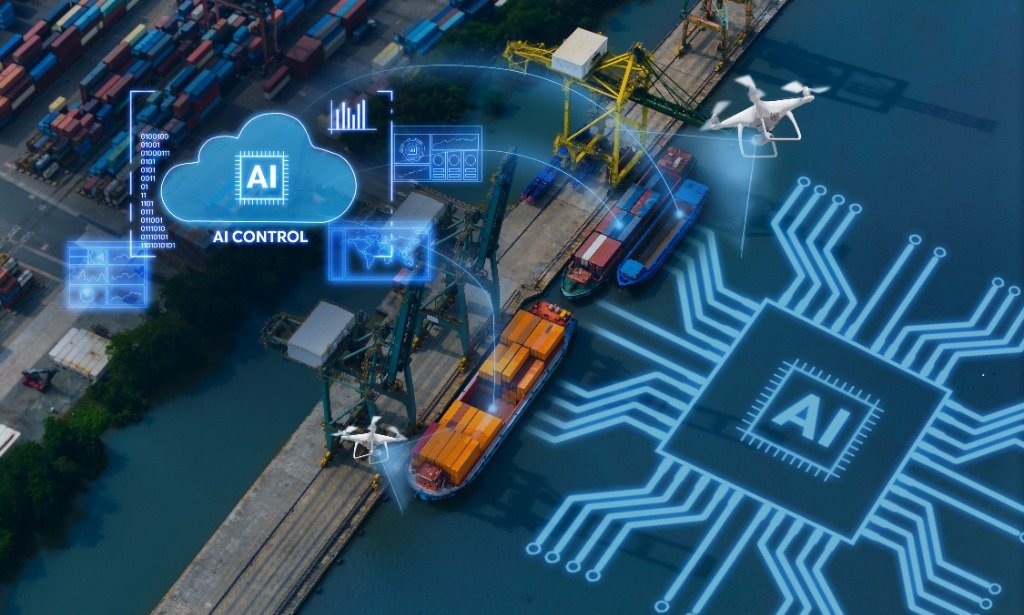
The solution is to invert the architecture. Instead of sending the video to the brain, EdgeVIQ brings the brain to the video. By installing industrial-grade, ruggedized inference servers directly on the vessel, the AI processing happens exactly where the data is generated: at the edge.
This approach, known as Edge AI, fundamentally solves the bandwidth bottleneck. The local server processes the high-definition video feeds in real-time, running dozens of concurrent machine learning models via dedicated local GPUs. It identifies anomalies, recognizes safety violations, tracks operational milestones, and manages perimeter security without ever needing to contact the outside world. The system remains 100% operational even if the VSAT dish is completely disconnected.
Transmitting Intelligence, Not Video
The genius of edge processing lies in how it handles the data after an event is detected. When EdgeVIQ detects a critical event, it does not attempt to stream a 10-minute video back to headquarters. Instead, it distills the event into lightweight intelligence that can be transmitted over the narrowest VSAT connection.
It sends a tiny metadata packet containing the exact timestamp, GPS coordinates, the event classification (e.g., "PPE Violation - No Hard Hat"), and a highly compressed 5-second video snippet or a single high-resolution keyframe of the incident.
This requires kilobytes of data, not gigabytes. The result is instant situational awareness for the shore team, zero bandwidth saturation, and a robust safety system that operates seamlessly even in the most remote and hostile maritime environments on Earth.